
For anyone who has had the question from the health and safety committee: ‘are they even allowed to keep us in here when it is 27 degrees?’
The short version: there is no maximum workplace temperature in law. The Workplace (Health, Safety and Welfare) Regulations 1992, regulation 7, require a ‘reasonable’ temperature, and the number sits in the accompanying Approved Code of Practice: normally at least 16 °C, or at least 13 °C where the work involves severe physical effort. Those are minimums. Above them there is no figure at all, and HSE’s reasoning is straightforward — no meaningful upper limit can be set, because the heat in a bakery, for instance, comes from the work itself and not only from the weather.
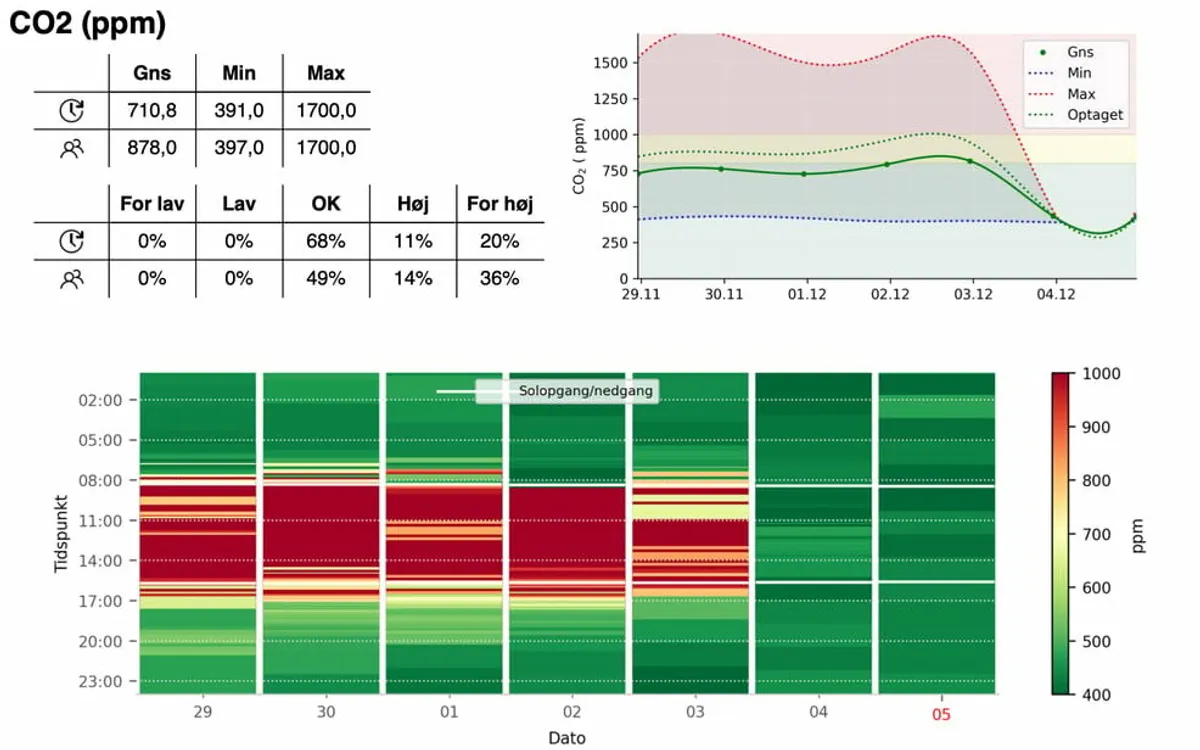
That missing number is the whole reason the discussion goes round in circles every summer. With nothing to point at, the case rests on the risk assessment instead: the employer’s duty comes from the Health and Safety at Work etc. Act 1974, and HSE expects a thermal comfort risk assessment once employees complain about the heat. CIBSE Guide A recommends an operative temperature of 21–23 °C in winter and 22–24 °C in summer for offices, but that is an industry standard, not legislation. A risk assessment is usually missing exactly one thing: measured data. That is what monitoring with Indoor climate in RoomAlyzer Air adds — when you know how many hours it went on, in which rooms, and whether it happened during a heatwave or on an entirely ordinary day, there is something concrete to work from.
The two kinds of too warm
There is a crucial distinction that is almost always missing from the discussion.
-
Too warm on an ordinary day: The room runs warm while the outdoor temperature is moderate. That points at the building: solar gain without shading, a system that cannot keep up, internal heat from equipment, or too many people for the room. It is something you can do something about, and something that ought to be done something about. CIBSE TM52 and TM59 are the recognised criteria for overheating in buildings without cooling, and they are about the design rather than about today’s weather.
-
Too warm during a heatwave: It is hot outside, and the inside follows. Here the expectation is measures — solar shading, ventilation, more breaks, access to drinking water, moving the work if it comes to that — not a guarantee of a particular temperature.
Without the outdoor temperature the two cannot be separated, and then every exceedance lands in the same pile. That is rarely fair to either side.
The report built for that conversation
Under Indoor climate → Analyses → Workplace heat you order a PDF documenting room temperature during occupied hours against one of two rule packages: AT 25 °C, which works from a fixed threshold of 25 °C, or ASR A3.5, which starts at 26 °C and has a set of steps above it. Both are available regardless of country. There is no UK package, because there is no UK threshold — British customers typically pick 25 °C or 26 °C as an internal threshold for the risk assessment, and it is worth being clear with everyone involved that the number is your own choice rather than a legal limit.
Ordering takes three steps:
- Rule package, period, occupied hours and outdoor source. The period can be 7 days, 1 month, this summer, last summer or dates of your own choosing. Occupied hours default to Monday to Friday 08–16, because those are the hours the case is about.
- Location and temperature sensors — up to 50 indoor sensors; outdoor sensors are kept out of the room figures.
- Recipients and language, and then the report is ordered. The PDF is generated on the server and sent by email.
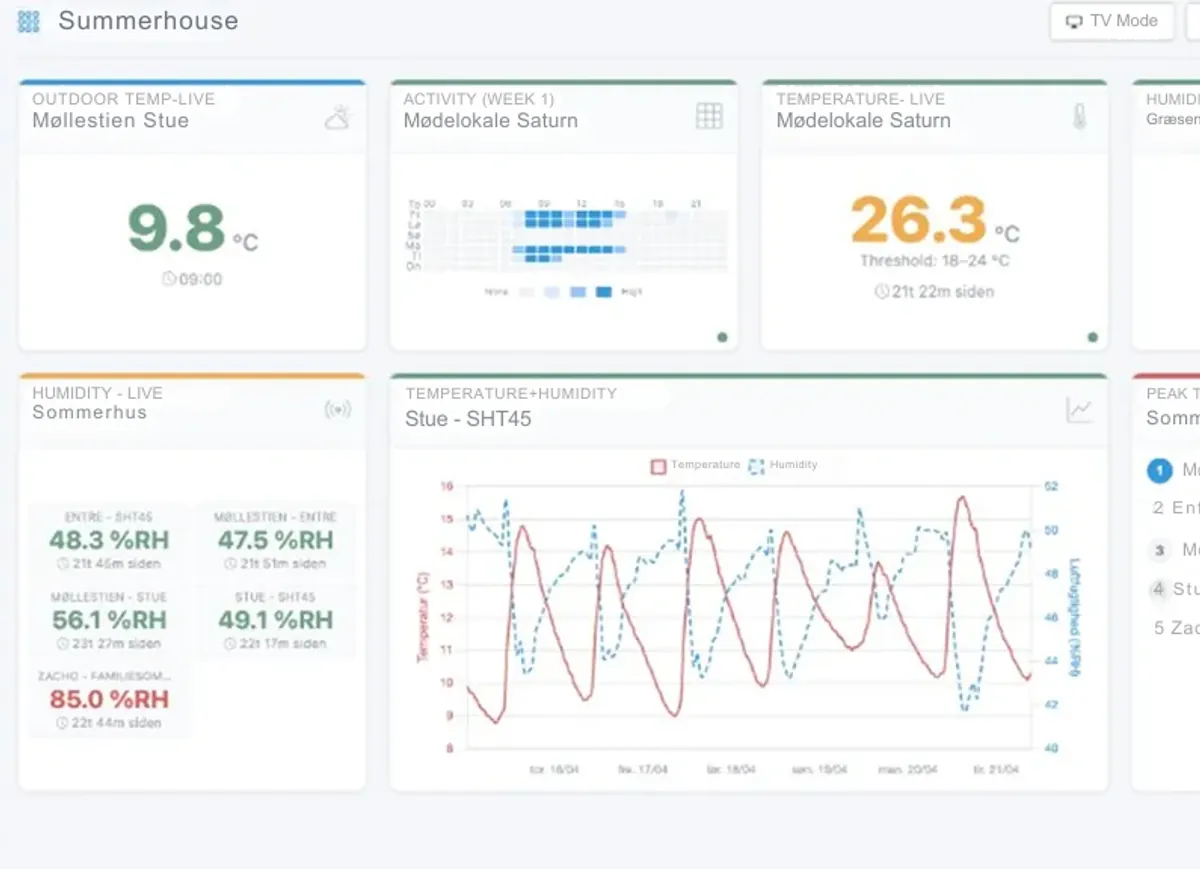
The outdoor source is what makes the distinction possible. If the location has no outdoor sensor, weather data is fetched from the location’s position on the map. If there is one outdoor sensor, it is used. If there are several, you have to choose — the system will not quietly fall back to weather data. Without a map position no outdoor figures can be fetched, and the hours are still counted, but they appear under ‘No outdoor’, because nobody can determine which kind of exceedance it was.
How to read the table
In the AT package in RoomAlyzer Air the room table has these columns; in the ASR package the threshold is 26 °C instead of 25 °C, with steps above it.
| Column | Meaning |
|---|---|
| Hours | Occupied hours with an indoor temperature |
| >25 / >32 | Hours indoors above that temperature |
| No outdoor | Indoors above 25 °C with no outdoor temperature available |
| Normal >25 | Indoors above 25 °C while there was no heatwave outside |
| Heatwave | Outdoors above 25 °C — measures are expected |
| Peak °C | Highest hourly average indoors |
The Normal >25 column is usually the one that settles the matter. Those are the hours when the room was too warm without the weather being available as an explanation.
Besides the table, the PDF contains a front page with caveats, key figures, the worst days, a calendar covering the whole reporting period with each day coloured by that day’s worst level, a bar chart of hours per week split into OK, above threshold and serious, and an AI analysis with a conclusion. The analysis is indicative and should be held up against the figures — it does not replace professional judgement.
An important distinction between operational monitoring and formal measurement
This is operational monitoring, not an accredited health and safety measurement. A formal measurement sets its own requirements for measuring height, radiation shielding and accuracy, and for how the outdoor temperature is measured. Where your sensors sit is your responsibility.
There is no button for sending people home because of the heat either, and that is deliberate: no temperature exists at which the law says work stops. What does exist is the duty to assess the risk and to act on what the assessment shows. That misunderstanding costs time every summer.
What the report can do is show what was actually measured during occupied hours, in which rooms, and when — and that is usually precisely what is missing when the discussion comes down to one assertion against another.
If you want the whole pattern behind the summer’s complaints, summer overheating is here. And if you need to follow the temperature continuously, temperature monitoring is here.